
Pathway to Stewardship and Kinship
An award-winning globally recognized framework for raising children who care for the Earth and one another.
A foundation for nurturing healthy and engaged children and youth. Through simple, age-linked “Landmark” activities that grow with them, children gain vital tools for physical and mental health, and lifelong relationships that bring joy and meaning to life
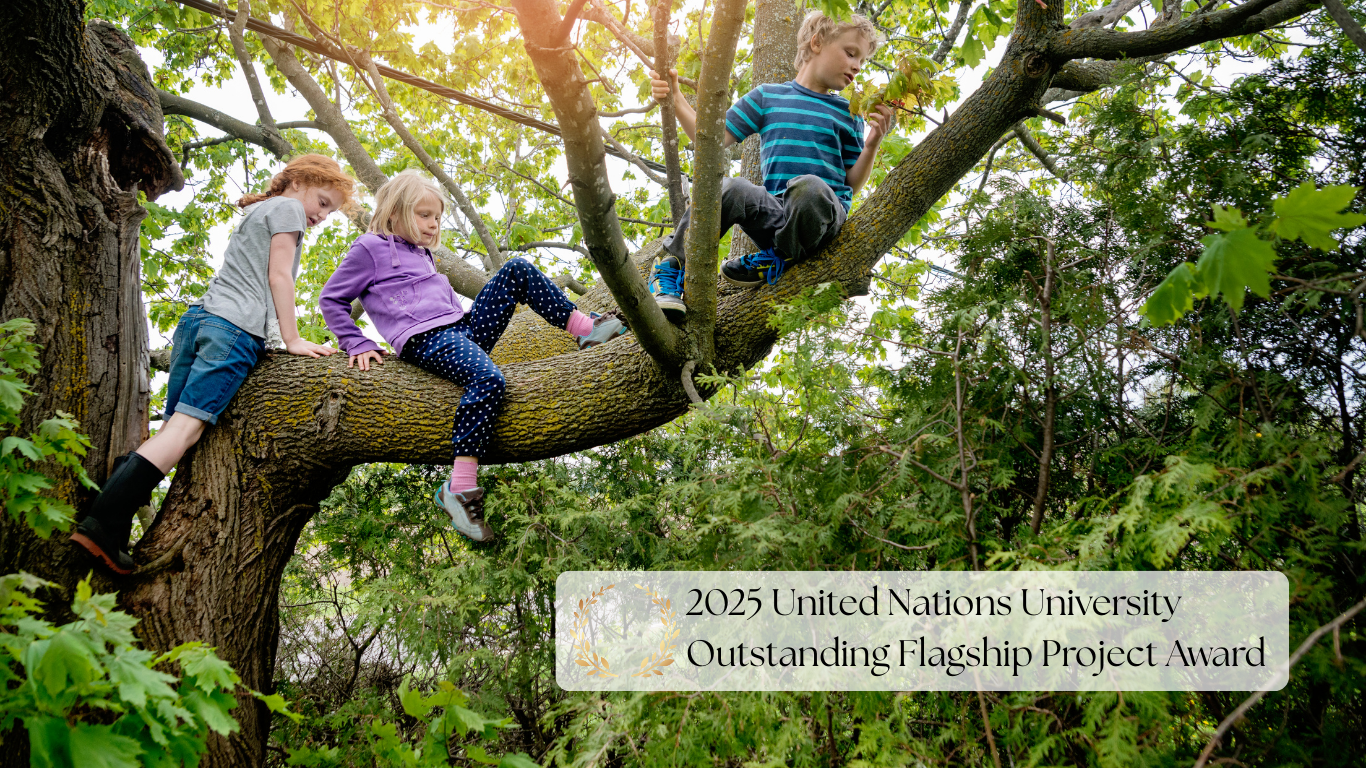
How do we raise children who care for the Earth and for one another?
When young people encounter environmental issues only through stories of loss and crisis, they can experience ecophobia or eco-anxiety, feelings of helplessness and disconnection. The Pathway responds by offering hopeful, developmentally matched experiences that empower children through action, relationship, and care.
Stewardship
A steward is someone who tends to and takes responsibility for the well-being of both human and more-than-human communities. Stewardship emphasizes care and responsibility.
Kinship
Kinship goes a step further: it recognizes that we are not separate from the living world but part of an interconnected community of relationships. It emphasizes belonging, reciprocity, and mutual flourishing.
Why Both Matter
A vibrant community depends on healthy ecosystems and healthy relationships, and the Pathway helps children and youth grow into citizens who not only care for the Earth but experience themselves as deeply connected to it.
A Research-Informed Framework from Birth to Young Adulthood
Beginning in 2015, Camp Kawartha, in special project coordinated by Cathy Dueck, worked with over 45 organizations including community groups, educators, health professionals, researchers, Indigenous Knowledge Holders to design a strategy that supports children from birth through young adulthood.
More than 80 regional leaders were interviewed to understand which childhood experiences most strongly nurtured lifelong care for the natural world. Their insights, combined with research, formed the foundation of this approach.
Thanks to funding from the Ontario Trillium Foundation, Community Foundation of Greater Peterborough, the Trent Community based research centre and our many donors, for supporting this initiative.
Developmental Landmarks
Partner Organizations
Community Leaders
Years in Development
The Landmarks
The Pathway is built around 30 “Landmarks,” developmentally aligned experiences that nurture connection, responsibility, and action at every age and stage of childhood. These landmarks are grounded in:
- child development research
- educational theory and environmental pedagogy
- wellness and mental health research
- community-informed knowledge and Indigenous wisdom (shared with deep appreciation and respect)
Explore Outside Together
Meet Animal Friends
Exercise the Senses Every Day
Visit a Favourite Outdoor Place Each Week
Help In A Garden Or Look After An Animal
Play in Nature Often
Share Books, Songs and Games About Nature
Make Some Nature Art
Visit Your Own Special Outdoor Place
Plant Something You Can Eat
Celebrate Each Season In The Year
Meet the Friends in Your Neighbourhood
Travel On A Familiar Route
Learn New Outdoor Activities
Try: Gardening, Feeding Birds, Finding Critters, Exploring
Explore Renewable Energy
Try a New Sport, Craft and Survival Skill
Celebrate a Local Natural Area
Explore Biodiversity
Plan an Environmental Project
Meet People From Other Cultures
Become a Citizen Scientist
Design Your Own Healthy Home
Calculate Your Ecological Footprint
Develop Three New Outdoor Skills
Volunteer To Help in Three Different Ways
Go On A Wilderness Trip
Rehabilitate Something Living That Has Been Damaged
Explore A Local Social Justice Issue
Describe Your Ecological Self
Internationally Recognized. Community Rooted.
The Pathway to Stewardship and Kinship has grown from a regional initiative into an internationally recognized model of sustainability education.
In 2025, the program received the United Nations University Outstanding Flagship Project Award, recognizing it as a leading global example of Education for Sustainable Development.
The Pathway is also housed within and supported by the RCE Peterborough/Kawartha/Haliburton, a Regional Centre of Expertise in Sustainability Education designated by the United Nations University. Learn more about the RCE network:
https://www.rcekawarthas.com
Why It Matters
Research consistently shows that meaningful childhood experiences in nature support both personal well-being and lifelong stewardship. Time outdoors strengthens creativity, resilience, self-esteem, and mental and physical health, while fostering empathy, responsibility, and a sense of belonging within the living world.
The Pathway recognizes that children need positive, age-appropriate stewardship experiences that build gradually over time. When young people encounter environmental issues only through stories of loss and crisis, they can experience ecophobia or eco-anxiety, feelings of helplessness and disconnection. The Pathway responds by offering hopeful, developmentally matched experiences that empower children through action, relationship, and care. As children grow, these experiences help transform concern into confidence, helping them feel capable, connected, and motivated to contribute to the well-being of the Earth.
The Pathway to Stewardship and Kinship serves as a call to action for everyone who works with children:
- parents and caregivers
- teachers, schools and administrators
- health professionals
- community organizations
- governments and planners
The framework aligns with curriculum goals while offering practical ideas for family life, community programming, and outdoor education. The more widely it is embraced, the deeper the benefits, supporting children to grow not only into knowledgeable citizens, but into active stewards and kin within a living, interconnected world.
From Pathway to Movement
Camp Kawartha is currently exploring launching a bold next step – the creation of a Centre for Earth Stewardship and Kinship.
The Centre will serve as a collaborative hub to:
- expand the Pathway model across communities
- support educators and organizations implementing landmark learning
- deepen research and evaluation
- build national and international partnerships
- strengthen storytelling and public engagement around nature connection and stewardship
The goal is simple but ambitious: help raise generations who see themselves as part of the living world and who are prepared to care for it. If you are interested in learning more please contact Jacob Rodenburg, Camp Kawartha’s Executive Director jacob@campkawartha.ca
A Living Framework that Lives on…
The Pathway to Stewardship and Kinship is not a finished product. It is a living, evolving community conversation.
It began in Peterborough, but its principles can be adapted anywhere communities wish to nurture healthier relationships between people and place. It is grounded in a shared hope: that children today can grow into caring, resilient adults capable of stewarding a vibrant future.
Resources
The Pathway’s ideas have also reached wider audiences through books, articles, films and blogs.
The Pathway to Stewardship and Kinship Website: www.pathwayproject.ca
The Pathway Project website brings the framework to life through practical tools, including videos, activity ideas, and resources organized by developmental stage and Landmark.
The Wild Path Home: A Guide to Raising the Earth Stewards of Tomorrow
https://newsociety.com/book/the-wild-path-home/
Co-authored by Jacob Rodenburg and Cathy Dueck, this book translates the Pathway framework into a practical guide for parents, educators, and community leaders. It offers research-informed strategies, activities, and the full landmark journey from early childhood through adolescence. Paul Hawkens, the author of Carbon, Regeneration and the Book of Life says: “without question this is the finest book on raising children I have ever seen.”
The Wild Path Home: Documentary Film
This award-winning documentary tells the story of the movement to reconnect children with nature and community through outdoor learning and shared responsibility. Together, the book and film help bring the Pathway’s message to audiences across Canada and beyond.
Watch the Trailer: https://www.thewildpathhome.ca/
Pathway Theory of Change: Pathway to Stewardship and Kinship — Theory of Change
https://campkawartha.ca/wp-content/uploads/PathwaysToStewardship_TheoryOfChange_Final.pdf
Our Theory of Change illustrates how individual experiences, community supports, and system-level partnerships work together to cultivate long-term stewardship and kinship. It maps the progression from early nature connection and relationship-building toward growing confidence, agency, and collective action. By identifying the conditions, partnerships, and developmental supports required at each stage, the model helps communities understand how sustained, coordinated efforts can create lasting social and ecological impact.
Research & Publications
The Pathway has contributed to academic and professional dialogue on sustainability education, including:
- Co-Authored a chapter with Nicole Bell in Environment EarthEd: Rethinking Education on a Changing Planet. Pathways to Stewardship – State of the Planet: World 2017 edition.
- Chapter in Book by Springer: Supporting New Teachers in Environmental and Sustainability Education: The Pathway to Stewardship and Kinship by: Jacob Rodenburg and Paul Elliott
- Co-authored with Paul Elliott SDG3 – Good Health and Wellbeing: Re-Calibrating the SDG Agenda: Concise Guides to the United Nations Sustainable Development Goals
- Canadian Journal of Environmental Education – Activating teacher candidates in community-wide environmental education: The Pathway to Stewardship and Kinship Project: Paul Elliott, Cathy Dueck, Jacob Rodenburg. Vol 23, no. 1
- Green Teacher – The Pathway to Stewardship and Kinship (cover story), Summer 2017, issue 113
- Pathway to Stewardship and Kinship: Raising Healthy Children for a Healthy Planet – in house publication: pathwayproject.ca .
- Eco Parent – How to Teach Children to Care About the Environment, nurturing environmental stewardship at every age By Jacob Rodenburg, 22 August, 2019
Help Raise the Earth Stewards of Tomorrow
The Pathway to Stewardship and Kinship invites us to move beyond concern and into collective action, to raise a generation that sees the Earth not as a resource to use, but as a community to belong to. If we want resilient children, thriving communities, and a living planet that flourishes for generations to come, the time to act is now. Join us in nurturing the stewards and kin our world so urgently needs.